

Cha In Pyo: Reflections on Life, Art, and Korean Literature
During his visit to Istanbul University, Cha In Pyo—renowned actor, novelist, and humanitarian—met with students and readers who had long admired both his art and his integrity.Over the years, his voice has evolved beyond the screen, finding a new language in writing—one that explores faith, compassion, and the quiet strength of humanity.In this exclusive interview, he reflects on what freedom means to an artist, the invisible bond between creator and audience, and the memories of his Turkish friends that still echo in his heart after four decades. Through his words, Cha In Pyo reminds us that storytelling is not only about imagination, but also about connection—the kind that transcends borders, time, and culture.
This interview was conducted via e-mail between October 24 and November 8.

1- Over the years, your work as a novelist has become just as defining as your career in acting. What does writing give you that acting never could?
Acting is a tool to express the writer’s world. As an actor, you can create your own way of expressing something within your role, but it’s still a creative act allowed only inside the frame set by the writer. At some point in my acting life, I started to want more than just to be a tool of expression. I wanted to become the purpose of expression itself. That’s when I began to write novels. Creation, to me, means crossing existing boundaries to build and expand new worlds. Beyond those boundaries lies an unknown land no one has ever explored. Crossing into that land brings both freedom and unease, but when that unease turns into joy, it feels like the awe of a human seeing nature for the first time, or a newborn experiencing the world for the very first time. So for me, the true reward of writing is freedom and wonder.
2- When you write, you create worlds from silence; when you act, you bring someone else's world to life. How do these two forms of expression complement or challenge each other?
Writing is a solitary act. It’s a decision and an execution made alone. That means all responsibility and obligation rest solely on oneself. Working alone brings both freedom and loneliness. Acting, on the other hand—especially in the world of commercial films and dramas — is based on a promise to stay faithful to the role given within a collective effort, not on one’s individual will. In that team-based work, freedom is naturally limited. Yet at the same time, responsibility, duty, and loneliness are also shared and therefore lighter. I believe this relationship between freedom and loneliness is what distinguishes the solitary act of writing from the collaborative work of acting.
3- In "What Happened to Mr. Cha?", you portrayed a version of yourself confronting fame and identity. Was that film, in some way, a dialogue between your past and present self?
I think the character “Cha In-pyo”, as seen externally, in the film, is quite similar to me in real life. In the story, he’s a former star whose popularity has died after a series of box-office failures, and he can no longer find work—much like what could happen to any actor in that situation. So I could think and act as he does in the film, not only as an actor but also as a person who has faced similar moments in life. However, each person lives by and strives toward different values. These values are not tied to professional success; they are inner goals that can’t be seen or measured from the outside. The director, I believe, tried to capture and portray me as someone judged by society’s external standards. But that version of me is quite different from who I really am and what I truly aim for inside. That’s why I chose to take part in the film —because, to me, it was a comedy.
4- Many of your novels explore faith, hope, and the quiet strength that sustains people through hardship. Do these themes reflect your personal philosophy of life?
The reason I write novels is to experience the freedom and wonder of creation. The goal of my writing is to give strength to people living in our time —to share pain and suffering, to help, comfort, and support one another. Without that purpose, I don’t think I could devote years of my life to writing a single book.
5- Your novel "Mermaid Hunt (인어 사냥)" has been mentioned by many students as inspiring and thought-provoking. After hearing their impressions, I became really curious about it myself. When can Turkish readers expect to see this book translated into Turkish?
I’ve signed a publishing contract for the Turkish edition so that the book will be released in Türkiye next year.
6- You were educated abroad and have experienced different cultures. How has this shaped the way you view art, identity, and humanity today?
I spent four years studying in the United States, and in total, I lived there for about five years. So I can’t say I had a particularly rich or long experience as an overseas student. But based on what I’ve learned through many experiences in life, I’ve come to realize that while the world is vast and people are diverse, all humans ultimately want the same things and fear the same things. We are all beings thrown into the space between birth and death, living each day while, at the same time, slowly dying. We all wish to live happily, yet most of us don’t even know exactly what happiness means —and that, too, is something we share as human beings. When you realize that people from different countries and races essentially share the same fundamental nature and desires, you begin to feel empathy and affection toward them. In the end, we draw strength from one another, we give and receive support, and we come to see that we are companions of fate, living together in the same era toward the same destination.
7- Your writing often highlights how small acts of kindness can leave lasting marks. What role do you believe artists play in nurturing empathy within society?
What every creator needs is a clear purpose for their creation. To make something without intention is an empty effort. If you think about it, almost nothing meaningful is ever created without purpose. That’s why I believe a creator must always ask: “Who is this work for?” Take a novel, for example. The writer writes the text, the publisher binds it into a book, and the bookstore places it on the shelf. At that point, every new book stands upright—closed. But a standing, closed book can never be read. Someone has to take it down, lay it open, and turn the pages. Only the reader can do that. So I believe that from the very start, a writer must keep the reader in mind. Only then can their words truly resonate and inspire genuine empathy.
8- Together with your wife, Shin Ae Ra, you've long been committed to social and humanitarian causes. Do you see your art and philanthropy as separate callings - or as part of the same purpose?
Whether it’s art or any other kind of work, what we do is simply a matter of choice, a part of our daily lives. We don’t constantly stop to decide what to do or not to do; we just try our best each day to live happily and wholeheartedly.
9- When you begin a new story, what usually comes first - a memory, a question, or an emotion? And how do you know when that story is ready to be shared with the world?
Feeling genuine affection for the subject you’re writing about is the most important thing. A novel is a long journey—sometimes lasting a year, sometimes many years. Suppose you can’t feel affection for your travel companion, your protagonist within the story, that long journey will turn into suffering. But if you do, it will become a joy.

10- During your university years, one of your close friends was Turkish, named Cevdet. Looking back, what memories or impressions do you have from that friendship? And how do you perceive Turkish culture today, especially its values and people?
Cevdet was four years older than me. I was an immigrant, and he was an international student. We first met while painting the bathrooms at a community college. What made us close was something I saw in him—a sense of dignity and manliness. We worked as assistant painters under a middle-aged white supervisor. That man used to call Cevdet “Turkey.” Cevdet politely told him, “My name is not Turkey, it’s Cevdet. Please don’t call me that again. ”But when the man said it once more, Cevdet looked at him and replied, “Yes, Yankee!” After that, the man never called him “Turkey” again. From then on, Cevdet and I became good friends, helping and depending on each other. Through him, I met another Turkish friend named Timur. The three of us often sat together in the student union building, talking about all sorts of things. Timur studied philosophy, and he used to explain to us ideas from Carl Jung’s analytical psychology. At that time, my English was poor, and the subject that Timur was explaining to me was so difficult that I barely understood what he was saying. Still, I tried to sit down and listen to what he was saying because I enjoyed those intellectual moments. Not because I understood, but because I was thankful that he would let someone like me be a part of the intellectual conversation. Looking back now, I am sure he knew that I didn’t understand what he was saying at that time. Even so, he kept on going, maybe because of the same reason that I kept on listening. Maybe he was thankful to me for listening to him, even though I didn’t understand. Likewise, perhaps conversation is not about the result, but a process. So my best buddies at college at that time were two Turkish students, Cevdet and Timur. They had something in common: strong pride and quiet strength. Though they were international students at a college with no name, and they did not have much in their pockets, their eyes were bright, and their manners were gentle but strong. They carried themselves with confidence. When I recently met students at Istanbul University, I felt the same energy and confidence from both female and male students. Inside, I couldn’t help thinking, “Wow… they remind me so much of Cevdet and Timur—forty years ago.”
11- Having lived as an actor, author, and advocate, what message would you give to the younger generation who dream of creating something meaningful through their art?
We are all artists and creators because each of us uniquely shapes our own lives. Just as every artist needs an audience, every person also needs someone to watch, cheer, and believe in their journey. If you want to unfold your own dream, you must also support the dreams of others. When your gaze is fixed only on yourself, you can see no one but you. But when your eyes turn outward, you begin to see countless others. Dreams are meant to be shared with the world, so our eyes, too, should look outward. That is how we live together— by becoming each other’s audience, and by cheering for one another along the way.
*
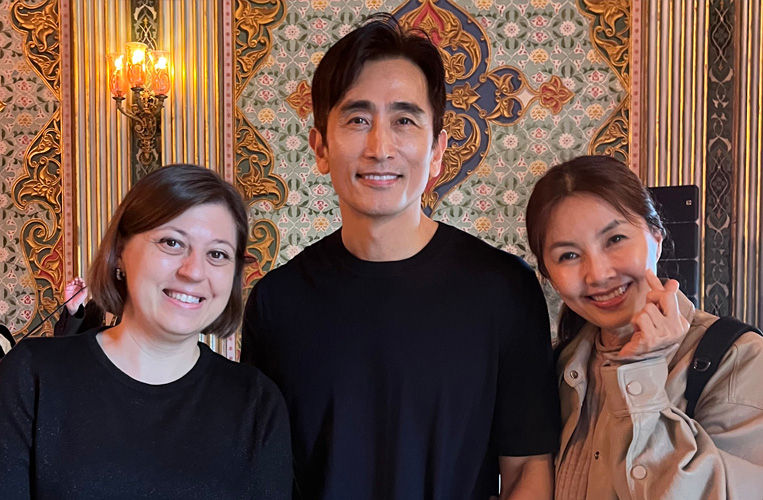
Once again, thank you for this meaningful conversation.I would like to express my sincere gratitude to Mr. Cha In Pyo for sharing his time, thoughts, and inspiring reflections.His visit to Istanbul University and his words in this interview continue to remind us that true art is born from sincerity, empathy, and hope.


Yorumlar